 English
 Español
 عربي
عربي Have you ever picked up a wine box or a perfume carton and immediately knew it was expensive—before even reading the brand name? That instant judgment comes from two finishes: metallic reflection and tactile texture.
These finishes are not accidents. They are the result of hot stamping and embossing—two processes that transform flat cardboard into a premium sensory experience. And when combined with a roll die cutter, they become something even more valuable: an efficient, inline finishing solution.
But here is the problem many packaging converters face. They buy separate machines for foiling, embossing, and die-cutting. Then they spend hours moving semi-finished stacks between stations, wasting labor and damaging edges.
Understanding the Two Techniques
Before diving into equipment configuration, let us clarify what hot stamping and embossing actually do.
Hot stamping transfers a metallic or pigmented foil onto the substrate using heat and pressure. A heated die presses the foil against the paper or board. The heat releases the coating from the foil carrier, and pressure bonds it to the surface. The result is a sharp, reflective mark that cannot be rubbed off.
Embossing raises or depresses the substrate to create a three-dimensional pattern. Unlike stamping, embossing does not add material. It reshapes the fiber structure. A male and female die pair compresses the board from both sides, pushing the design upward.
Both processes require precise temperature, pressure, and registration control. Get any parameter wrong, and you lose either the foil bond or the dimensional definition.
The Traditional Approach vs. Inline Integration
Most small to medium converters start with standalone equipment. A flatbed stamping machine here. A separate embossing press there. Then a roll die cutter for final shape cutting.
This approach has three hidden costs:
-
Registration drift. Each handling step shifts the sheet slightly. By the time you cut, the foil might be 1mm off position.
-
Edge damage. Moving partially finished stacks between machines bruises corners and scuffs surfaces.
-
Labor waste. Every unload-reload cycle adds operator minutes per thousand sheets.
According to a production manager at a mid-sized Egyptian packaging plant interviewed last year, switching from standalone to inline finishing reduced their reject rate from 6.8% to 1.2% within three months. The primary improvement? Registration consistency.
How Roll Die Cutter Integration Changes the Game
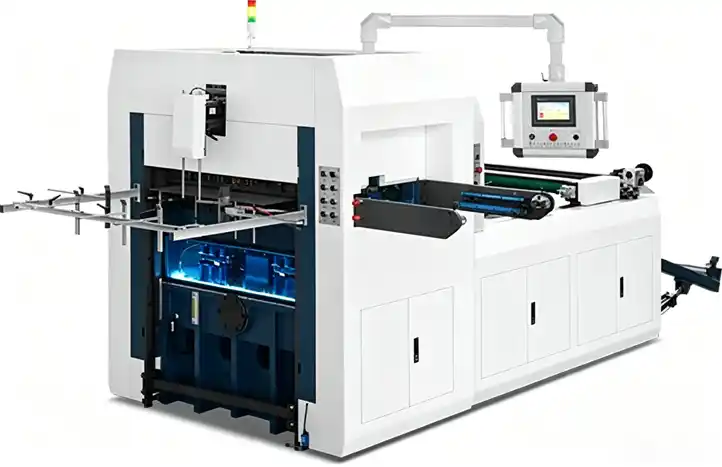
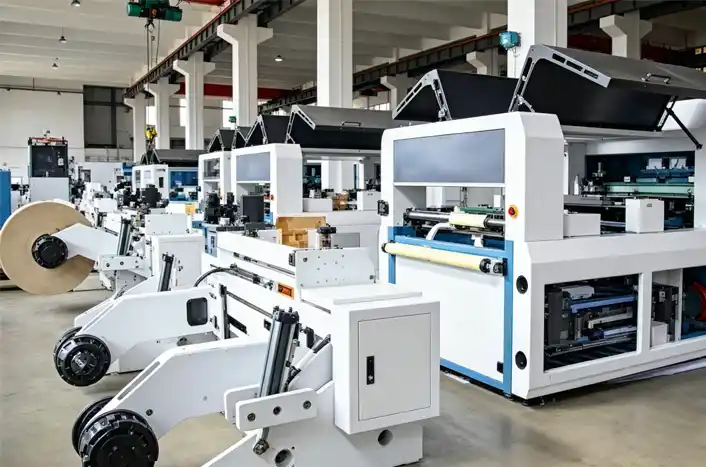
When hot stamping and embossing stations are integrated into a roll die cutter, the substrate stays on a single transport system from feed to finished blank. This inline configuration eliminates intermediate stacking completely.
The typical inline sequence works like this:
-
Unwinding or feeding – Sheets or a web enter the line.
-
Hot stamping – A heated foil transfer station applies metallic or pigmented layers.
-
Embossing – A matched die pair creates raised or recessed textures.
-
Die-cutting – The final station cuts the profile and waste stripping occurs.
Between each station, servo-driven pull rolls maintain sheet tension and registration. Optical sensors verify position marks every few hundred millimeters. If the registration drifts beyond tolerance, the system adjusts automatically—not after the batch ends.
Critical Parameters You Cannot Ignore
Experience from converting shops shows that most finishing defects trace back to three variables.
Temperature tolerance – Hot stamping
Aluminum foil typically requires 110–140°C. Pigmented foils need slightly higher, around 130–160°C. Too low, and the foil peels off easily. Too high, and the carrier film melts into the board or creates halos around the stamped area.
A practical tip: always run a temperature gradient test at the start of a job. Stamp five samples at 5°C increments. Check adhesion with tape after cooling. This five-minute test prevents thousand-sheet rework.
Pressure consistency – Embossing
Embossing pressure is measured in tons per square centimeter. Light pressure produces weak definition. Excessive pressure cracks the board fiber, especially on recycled stock.
For typical 300–400 gsm paperboard, starting pressure around 60–80 tons is a common baseline. But the real variable is anilox lock time. The longer the dwell, the deeper the emboss—within reason. Exceeding 0.8 seconds usually crushes rather than forms.
Die temperature control – Combined processes
Some modern finishing lines attempt hot stamping and embossing simultaneously using a heated embossing die. This is efficient but risky. The die must stay hot enough for foil transfer but not so hot that it burns the paper. A 10°C overshoot on a large embossing area can scorch the entire image.
Material Compatibility: What Works and What Does Not
Not every substrate plays well with foil and texture.
Coated papers generally perform best. The clay coating holds foil details sharply and embosses cleanly.
Uncoated offset stocks accept foil but may show fiber lift during embossing. Reducing embossing depth by 15–20% usually solves this.
Recycled board is the most challenging. Variable fiber density creates uneven embossing results. Foil adhesion suffers on areas with high ash content. If you must use recycled stock, specify medium-density board and expect to run slower—around 60–70% of standard line speed.
One packaging engineer from a Turkish folding carton producer noted that switching from standard to recycled board required reducing line speed from 80 m/min to 55 m/min. Below that threshold, foil transfer became unreliable. This is not a machine limitation—it is a material property.
Common Setup Mistakes and How to Avoid Them
Mistake 1: Ignoring foil width vs. stamping area
Using foil wider than the stamping area wastes material. Most modern systems allow narrow foil reels mounted on multiple mandrels. Match foil width to the actual image width plus 5mm margin.
Mistake 2: Misaligning the die cutting with foil mark
If your finished blank is cut 0.5mm off from the foil position, the carton looks misprinted even when the foil itself is perfect. Always cut from the same registration mark used for stamping, not a separate edge reference.
Mistake 3: Overlooking dust from waste stripping
Die-cut waste generates fine paper dust. That dust settles on foil reels and embossing dies. Over a shift, dust accumulation reduces foil transfer strength by nearly 30% according to internal tests from several Asian converters. A simple vacuum shroud placed after the stripping station prevents this.
When Should You Consider Inline Finishing?
For converters currently using separate stamping and die-cutting lines, the decision to integrate depends on three factors:
-
Volume stability – Do you run similar carton sizes and board types for at least two shifts per week?
-
Registration sensitivity – Does your customer reject packs where foil drifts by 1mm?
-
Floor space – Is your factory layout constrained, making material handling between machines inefficient?
If you answered yes to at least two of these, inline finishing through a roll die cutter likely offers both quality and labor savings.
The technical specifications for different inline configurations vary significantly based on maximum substrate width, foil mandrel capacity, and embossing pressure range. For converters evaluating specific throughput scenarios, reviewing detailed layout drawings and parameter tables is a logical next step. Review inline finishing configuration options.
Beyond Foil: The Growing Demand for Tactile Packaging
Market data from Smithers (2024 Packaging Finishing Report) indicates that tactile embossing grew 11% year-over-year in luxury packaging segments, outpacing standard foil stamping at 5%. Consumers increasingly associate texture with authenticity. A matte soft-touch coating combined with deep embossing signals "craftsmanship" more effectively than bright foil alone.
This trend pushes converters toward more versatile finishing lines. The ability to change between shallow micro-embossing (for security labels) and deep structural embossing (for book covers) on the same equipment reduces capital expense.
Final Advice for Buyers
If you are specifying finishing equipment today, do not focus solely on maximum speed. Ask these three questions instead:
-
How fast does the registration system respond to drift? Milliseconds matter. Look for servo-driven pull rolls with encoder feedback.
-
Is the foil tension controlled per mandrel? Independent tension prevents wrinkling on multi-foil jobs.
-
Can the embossing unit be swapped for a flat stamping module? Flexibility protects you when order patterns change.
The most expensive finishing line is not the one with the highest price tag. It is the one that locks you into specific formats or materials that your next big client does not use.
For packaging converters handling premium cartons, security labels, or folding boxes, integrating foil transfer and texture embossing with die-cutting is no longer experimental. It is a proven efficiency gain.
If you are currently planning a line upgrade or a new finishing department, understanding how these three processes interact at production speeds will save months of trial and error. Compare integrated versus standalone finishing layouts.
Are you running into foil adhesion or registration consistency issues with your current setup? Sometimes the most practical starting point is retrofitting just the registration control system rather than replacing the entire press.