 English
 Español
 عربي
عربي Every operator knows that sinking feeling: the cross cutter starts leaving ragged edges, the blade has to be changed again, and another 45 minutes of production vanish. In a busy label or packaging shop, blade changes twice a week are considered “normal.” But what if that normality is just a symptom of a deeper mismatch between the cutting process and the material?
Last month, a plant manager in Ohio showed me a logbook. On his high-speed line for flexible packaging, the cross cutter blades were being replaced after as little as 300,000 linear feet. Each change meant stopping the entire converting line, recalibrating blade gap, and scrapping the first few yards of material. The annual cost in blades alone had crept past $12,000, but the real damage was hidden in 90+ hours of unscheduled downtime. His frustration echoed what many converters face: the cross cutter does the job, but it just can’t keep up with modern run lengths and thinner substrates.
Why Cross Cutter Blades Wear Out So Fast
The cross cutter operates on a guillotine principle — a straight blade moving up and down against a fixed bed or a rotating drum. The impact is sudden, the contact line is narrow, and the cutting force concentrates in a tiny area. When you add abrasive films, metalized layers, or thick laminates, that impact becomes a chipping machine. Three factors converge to destroy blade life:
-
Uneven pressure distribution. Even a 0.002-inch misalignment between blade and anvil translates into hotspots that dull a blade within hours.
-
Insufficient frame rigidity. Older or lighter cross cutters flex under load, especially at the edges of wide webs. That flex opens micro-gaps, inviting tearing rather than clean cutting.
-
Poor anvil surface condition. Once the anvil starts wearing, the blade compensates by smashing harder, accelerating its own end.
Replacing blades more frequently masks these root causes, but doesn’t fix them. And while you can upgrade blade material — moving from standard D2 steel to a powdered-metal alloy hardened to HRC 63 — the gain is often marginal when the machine’s mechanical structure is the limiting factor. To get beyond this cycle, some converters start to evaluate a rotary die cutting system that fundamentally changes how the cut is delivered.
A Different Cutting Philosophy
Instead of a chopping action, rotary die cutting uses a continuously rolling cylinder with an engraved or magnetic die that presses the material against a hardened anvil roll. The cut is gradual, almost a shearing motion, spread across the width of the die. Because the force is distributed and the engagement is constant, stress on the blade tip drops by an order of magnitude. The result isn’t just longer blade life; it’s a cleaner edge profile and the ability to cut adhesives and linerless materials that would destroy a cross cutter.
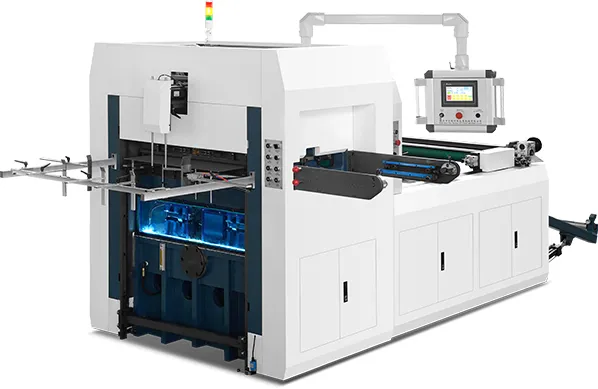
A critical side benefit is that rotary die stations can be part of a modular converting platform. The same machine frame that holds the die module can integrate slitting, waste stripping, and even an inspection unit — eliminating the standalone cross cutter entirely. This integration is why many high-mix shops, after analyzing their bottleneck data, migrate toward a modular rotary converting platform that offers more than just a blade swap.
What to Look for in a Rotary Solution That Actually Extends Blade Life
Not all rotary die cutters solve the wear problem. A poorly machined anvil or a die cylinder that runs eccentric will create the same hotspot issues as a misaligned cross cutter. The following design features directly correlate with blade longevity and cut consistency:
| Design Element | Impact on Blade Life | What to Check |
| Frame construction | Absorbs vibration, maintains gap | Cast iron or heavy-gauge steel with FEA-optimized ribs |
| Anvil roll hardness & runout | Prevents edge chipping | Surface hardness ≥ HRC 60, runout < 0.0004" TIR |
| Die cylinder bearing preload | Eliminates lateral play | Angular contact bearings with zero-clearance adjustment |
| Gap adjustment mechanism | Repeats cut pressure accurately | Wedge-type or differential screw with digital readout |
| Web path stability | Avoids flutter that hammers blade | Idler rolls with low-inertia bearings and fine tension control |
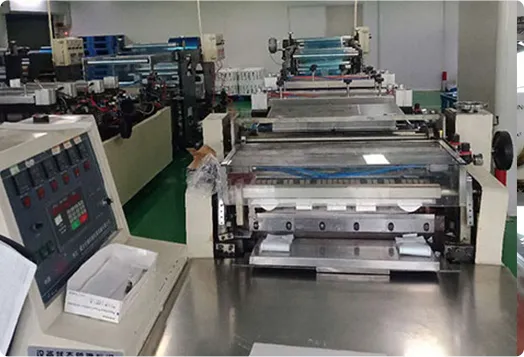
In one field upgrade I observed, a converter producing flexible packaging for pet food switched from a recalcitrant cross cutter to a heavy-frame rotary unit with a hardened anvil and automatic pressure compensation. Blade-related downtime dropped from 11 hours per month to under 2 hours. Annual blade consumption fell by 68%, paying back the equipment premium in 14 months purely on consumable savings. That kind of result depends heavily on the machine being equipped with automatically compensated rotary die stations that maintain consistent kiss-cut depth regardless of thermal expansion or roll wear.
When Does the Switch Make Sense?
Rotary die cutting isn’t a universal answer. If your runs are very short, the cost of a dedicated magnetic cylinder for each job can outweigh the savings. But a brief cost analysis often reveals a clear trigger point: if you’re changing blades more than once a week, or if blade-related downtime exceeds 2% of scheduled production hours, a move to rotary makes financial sense. Additionally, if you are contemplating adding a new product line that uses filmic or pressure-sensitive substrates that have historically been tough on your cross cutter, it may be wiser to design the line around rotary cutting from day one.
A Smoother Path Forward
If you’ve been managing blade changes as a routine expense, stepping back to examine the entire cutting system can reveal a path to significantly lower maintenance overhead. Rather than continuing to fight the symptoms with premium blades and more frequent alignments, consider a machine architecture that addresses the root mechanical causes. Purpose-built rotary cutting technology changes the nature of the cut from impact to shear, and when properly engineered, it reduces the blade replacement ritual to a quarterly or even semi-annual event.
For operations that are ready to reclaim those lost production hours, it’s worth exploring Changcheng’s integrated rotary cutting solutions. With a focus on vibration-dampened frames, precision-ground roll geometries, and modular configurations that adapt to materials from 20-micron films to heavy carton stock, these systems are built to transform a constant headache into a reliable, predictable process.