 English
 Español
 عربي
عربي A veteran operator walks the floor at 3:15 AM, pulls a finished roll from the rewinder, and unfurls a meter of film against the light. There it is — a wandering crease, subtle but enough to scrap 40% of the roll. The knives were changed only two shifts ago. The operator mutters the same assumption most converters make at first: “Blade problem.”
Nine times out of ten, it’s not. Wrinkles that appear post-slit, especially on extensible films, thin PET, laminates, or coated papers, are overwhelmingly a tension control problem. Fix the tension, and the creases disappear without touching a blade.
If your site has battled intermittent wrinkling for months and the usual fixes — new blades, different anvil rings, adjusted draw — haven’t held, this breakdown will help you trace the real cause and build a control strategy that sticks.
The Real Culprit: Where Tension Goes Wrong
Web tension is simply the longitudinal stress in the material as it moves from unwind to rewind. The trouble is that “tension” isn’t one number. There are at least three distinct zones — unwind, slitting nip, and rewind — and the web has a frustrating memory. A tension upset 10 metres upstream prints itself into the finished roll 30 seconds later.
The most common wrinkle-inducing failures we’ve documented across dozens of converting lines include:
-
Unwind oscillation – A jerky unwind stand sends a tension spike down the web. Extensible films elongate, then relax, forming transverse ripples that look like wrinkles.
-
Poor nip geometry – If the draw between the nip and the rewind isn’t controlled to match the material’s modulus, the web can drift sideways or form puckers at the slit edges.
-
Taper tension mismatch – The rewind builds diameter and changes speed. Without the correct taper profile, outer layers crush inner layers, and axial shifting shows up as creases near the core.
-
Air entrainment – At speed, a boundary layer of air gets dragged into the rewind roll. This reduces interlayer friction, letting individual laps slip and wrinkle.
The underlying physics hasn’t changed since the converting industry moved from centre-wind to more sophisticated surface/centre-wind designs: every material has a tension window. Below it, the web sags and tracks poorly. Above it, you induce strain that manifests as permanent deformation — or worse, as a hidden wrinkle that only appears days later as the roll equilibrates. For a quick field check, many engineers reference the <1% elongation rule of thumb (based on Hooke’s law for elastic films), but modern multi-layer structures often require a far tighter window, sometimes as narrow as ±2 N across the full width.
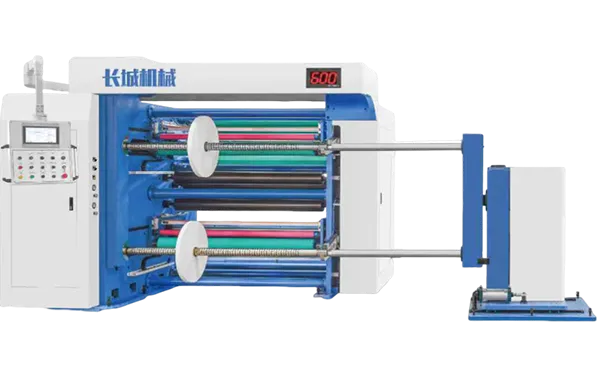
Closed-Loop vs. Open-Loop: Why Your Manual Setting Isn’t Enough
An open-loop tension setup — a manual potentiometer setting a brake pressure or a basic drive torque — can work for thick, stable substrates running at constant speed. But as soon as you introduce thin films, extensible materials, frequent speed changes, or roll build-up that alters inertia, open-loop becomes a gamble. The operator can’t react fast enough to diameter change and transient disturbances, and the result is the kind of random wrinkle that frustrates a whole shift.
Closed-loop control changes the equation. A load cell or dancer roller continuously measures actual web tension, compares it to a setpoint, and adjusts the actuator (brake, motor, or clutch) in real time. Modern systems running a PID loop with feedforward from line speed can hold tension within 1–2% of setpoint, even during acceleration and deceleration. This isn’t just instrumentation — it’s a philosophy: let the machine tune itself faster than any human can.
In a recent retrofit we studied, a label converter running 12 µm PET switched from manual unwind brake control to a closed-loop system with a precision low-inertia load cell and a digital drive. Wrinkle-related waste dropped from 3.8% of total output to under 0.4%. The payback period, including installation, was less than four months. These figures align with industry benchmarks published by the Converting Equipment Manufacturers Association, which consistently show that tension upgrades deliver the highest ROI among all retrofit projects on a slitting line.
If you’re currently evaluating how to move from manual adjustments to an automatic, sensor-driven strategy, it’s worth exploring systems that integrate real-time tension feedback into both unwind and rewind sides as a unified package rather than bolting on point solutions.
The Dancer vs. Load Cell Decision — and When You Need Both
A question that surfaces in almost every tension troubleshooting session is, “Should I use a dancer or a load cell?” The answer depends more on the material than on the machine.
-
Load cells measure tension directly. They’re fast, accurate, and ideal for stiff materials where elongation is small. But they need a stable wrap angle and clean signal processing — vibration or electrical noise can corrupt the measurement.
-
Dancer rollers are energy-absorbing devices. They mechanically store and release web length, acting as both a sensor and an actuator. For extensible films, nonwovens, and any material that stretches under its own weight, a dancer provides the buffering a load cell alone cannot.
Most high-performance converting lines today use a hybrid: a load cell for tension reference and a dancer for rapid mechanical response. The load cell tells the system what the true tension is; the dancer takes care of the high-frequency disturbances that would otherwise saturate the control loop. When paired with a properly tuned drive, this combination can handle speed ramps of 300 m/min or more without leaving a mark on the finished roll.
A practical lesson from the field: if you’re slitting multi-layer laminates with a metalized layer, pay extra attention to the dancer’s surface finish and inertia. A metalized web can be remarkably friction-sensitive, and a heavy dancer roller with a worn coating will create drag lines that mimic tension wrinkles. This is exactly the kind of nuanced detail that separates a reliable setup from one that generates endless operator complaints. For converters looking to eliminate such variables from the start, selecting a web handling platform engineered for low-inertia response can dramatically shorten the commissioning curve.
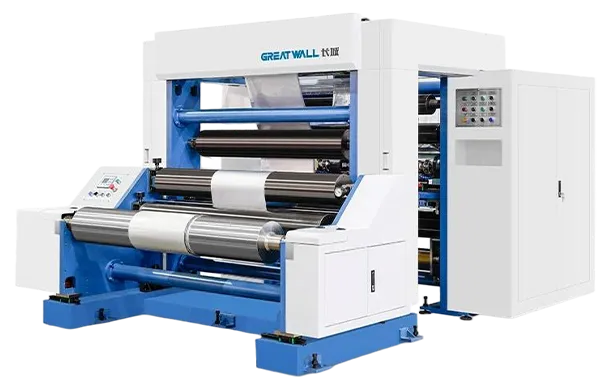
Three Daily Checks That Prevent Most Wrinkles
Even the best control architecture won’t save you if mechanical fundamentals drift. Before blaming the drives, spend 10 minutes on these checks:
-
Idler roll alignment – With a straightedge and a digital inclinometer, verify that all idlers are parallel to within 0.1 mm across the web width. A misaligned idler steers the web and creates a diagonal tension differential that turns into a wrinkle at the first slitting point.
-
Nip roll condition – Check rubber-covered nip rolls for wear, glazing, or uneven hardness. A nip roll with a 5 Shore A hardness variation across its face will deliver unequal traction, stretching one side of the web more than the other.
-
Core concentricity and chucking – A core that runs out by even 0.25 mm induces a once-per-revolution tension spike. At 500 RPM, that’s over eight pulses per second — far beyond what a PID loop can fully cancel. Use dial indicators during chucking setup and reject damaged cores without exception.
Document these inspections. A simple log that records alignment values, nip roll Shore readings, and core runout will reveal drift patterns months before they cause scrap. Many maintenance teams discover that what they labeled “random wrinkles” were actually periodic and perfectly correlated with idler bearing replacement intervals.
When the Material Is the Wildcard
Sometimes tension settings that worked for the last six months suddenly produce wrinkles on a new batch of the same specified material. The culprit is often variations in coefficient of friction, thickness profile, or residual stress from the film manufacturing process. A cast film and a blown film of identical gauge and resin can require a completely different tension taper because their stress relaxation behaviors differ.
Here, the machine’s ability to adapt matters more than the static recipe. Advanced drives with automatic taper calculation — where the system measures rewind diameter, material width, and speed, then continuously adjusts the torque curve — can compensate for incoming material variation that a fixed recipe cannot. If you process film from multiple suppliers or deal with seasonal humidity changes affecting paper substrates, this adaptive capability is no longer a luxury; it’s a waste-avoidance tool.
A Smarter Path to Wrinkle-Free Output
Solving slitting wrinkles permanently usually requires moving beyond the “one adjustment at a time” approach. It means looking at the entire web path as an integrated system, from the way the unwind brake is controlled to how the rewind mandrel accelerates and how the idler rolls are maintained. When these elements are designed to work together with closed-loop tension regulation, the operator isn’t constantly firefighting — the line just runs.
If you’re ready to explore a setup that brings together precision mechanical design, closed-loop tension control, and adaptive rewind strategies in a single platform, Changcheng’s custom web converting systems are built with exactly these interactions in mind. The engineering team focuses on matching the entire tension architecture — from dancer geometry to drive response — to the specific film, laminate, or paper you run every day. For a deeper dive into configuration options or to discuss a trial with your own material, feel free to request a technical consultation; a detailed discussion about your current winding profiles often reveals improvement opportunities that don’t require a full line rebuild.
Ultimately, wrinkles are just the web’s way of telling you where the tension path broke. Listen to it, instrument it, and you’ll turn what was once a recurring scrap event into a solved chapter.