 English
 Español
 عربي
عربي Imagine you’re running a 12‑micron BOPP film at 400 meters per minute. The unwind roll is fresh, the coating station is dialed in, and then it appears — a fine lateral wrinkle snaking across the web, just before the winding drum. By the time you react, 800 meters of material are already crinkled into scrap. If this scene sounds familiar, you’re not alone. In thin‑film converting, wrinkling is the silent yield killer, and the culprit almost always traces back to tension control — or the lack of it.
Understanding why thin webs wrinkle requires stepping inside the converting process. Film is an elastic material; when tension distribution across its width becomes uneven, the web buckles to relieve stress. At high speeds, this instability triggers oscillation and permanent creasing. The root causes are manifold: slightly misaligned idler rollers, diameter‑build‑up on the rewind, inertia during acceleration or deceleration, and temperature fluctuations that alter material modulus. In an open‑loop system, the operator sets a nominal tension value, and the drive simply tries to hold a corresponding motor current. But open‑loop control cannot compensate for real‑time changes — friction variations in bearings, out‑of‑round rolls, or even air humidity that changes the coefficient of friction. As a result, the actual web tension can drift by 15–30%, creating ideal conditions for wrinkles. Industry surveys consistently show that improper tension contributes to over 70% of web‑related defects in thin‑film processing. The financial drain is staggering: lost raw material, machine downtime, and delayed shipments. That’s where a more intelligent approach becomes critical. Many converting shops have discovered that investing in advanced web tension management yields a rapid return through waste reduction alone.
The move from open‑loop to closed‑loop tension control fundamentally changes the equation. In a closed‑loop configuration, a sensor — typically a load cell, a dancer roller with a position transducer, or a strain‑gauge‑based tension amplifier — continuously measures actual web tension and feeds a signal back to the controller. The controller compares this feedback with the setpoint and instantly adjusts the torque command to the unwind brake or the motor drives. Modern systems execute this loop hundreds of times per second using PID algorithms, and the best ones automatically adapt gains based on line speed and roll diameter. For fragile films under 20 microns, this real‑time correction is not a luxury; it’s the difference between a perfectly flat roll and a crinkled mess.
Consider what happens during emergency stops or rapid speed changes. A roll with large inertia tends to over‑speed momentarily, creating a slack section that later snaps tight — the classic recipe for wrinkling. A closed‑loop dancer system absorbs that excess web mechanically and gives the drive a buffered correction window. Meanwhile, load‑cell‑based feedback can immediately reduce unwind torque, preventing the tension spike. Some converters are now adopting integrated closed‑loop converting systems that combine dancer feedback with load‑cell trimming to deliver both the fast mechanical response and the high precision of electronic control.
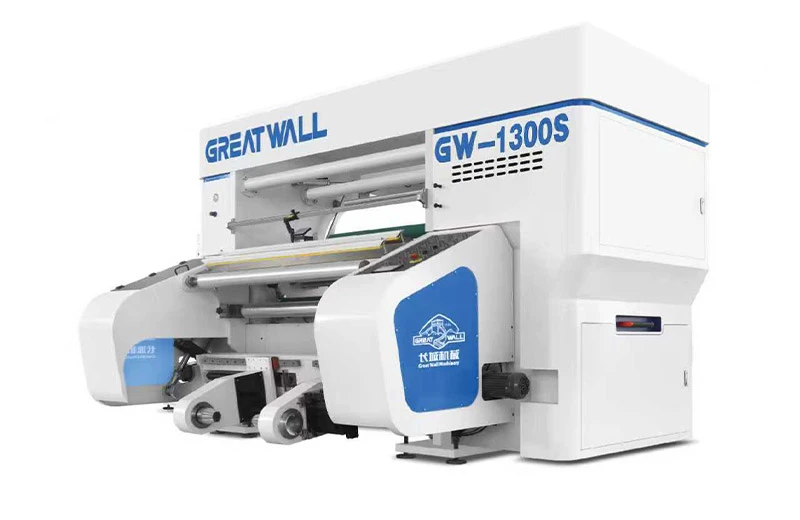
Beyond instantaneous correction, closed‑loop architectures allow for sophisticated taper tension profiles during winding. As the roll diameter grows, the pressure exerted on inner layers increases exponentially, causing them to buckle and form “star‑shaped” or telescoped defects. A closed‑loop controller can smoothly reduce tension setpoint — often following a hyperbolic or linear taper — based on the real‑time diameter measured by a sensor. When this taper is tuned correctly, the roll builds with even hardness from core to outer wraps, virtually eliminating in‑roll wrinkling. For film slitting machines handling shrink‑sensitive substrates, this feature alone can boost first‑quality yield by 8–15%.
However, technology alone isn’t a silver bullet. I’ve seen plants where a high‑end closed‑loop system couldn’t stop wrinkling simply because a misaligned idler roll had been overlooked. The web doesn’t care how advanced the control algorithm is if it has to travel over a roller with 0.5° angular error. A holistic setup checklist should include: laser aligning all rollers within 0.1 mm/m parallelism, selecting proper roller surface coatings (such as plasma‑coated ceramic or textured rubber) that match the film’s coefficient of friction, verifying that load‑cell mounts are free of mechanical bind, and ensuring the controller’s filter settings aren’t masking real tension ripple. In one case, a converter improved wrinkle‑free running speed by 30% just by switching to a grooved idler that broke up the air boundary layer on a glossy film — a simple mechanical fix that multiplied the effectiveness of the electronic control.
A common pitfall is treating the unwind and rewind zones in isolation. Tension disturbances propagate: a sudden snatch on the unwind can travel through a coating nip and disturb a delicate lamination. That’s why forward‑thinking operations are now linking tension loops across the entire line, so that the rewind speed profile is dynamically skewed based on the tension readings from the process section. This coordinated control approach, often referred to as “cascaded tension master‑slave architecture,” is becoming standard in high‑speed lines running below 12‑micron films. If your current setup still relies on manually tuned potentiometers, it may be time to evaluate precision roll‑to‑roll finishing equipment that natively supports distributed tension control.
Preventive maintenance plays an often‑underestimated role in anti‑wrinkling. Load cell calibration should be verified at least every six months using a known weight or certified load rig. Dancer cylinders need consistent air pressure, free of moisture or oil contamination that causes stiction. Even the electrical noise from a nearby variable‑frequency drive can inject false ripple into the tension signal, so cable shielding and proper grounding should be checked during annual inspections. Document these checks; operators who see a trend of drifting sensor zero‑offset can intervene before wrinkles appear.
So, where does this leave the converter who wants to move from reactive firefighting to predictable, high‑speed production? The path is clear: start by auditing the mechanical condition of the web path, then layer in a true closed‑loop tension system capable of high‑speed digital communication and multi‑zone coordination. When such a system is properly implemented, the results are tangible — rolls that feel consistently dense to the knuckle‑tap, zero‑wrinkle edges under a microscope, and converting lines that run through shift changeovers without a hiccup.
If you are looking to bring this level of consistency to your own production floor, solutions that combine closed‑loop tension algorithms with rigid, vibration‑damped frame structures are worth exploring. Changcheng, for instance, has focused on developing Changcheng’s high‑performance converting solutions that integrate fast‑response tension control, automatic taper calculation, and user‑friendly recipe management — directly targeting the root causes of thin‑web wrinkling. Whether you’re running packaging films, battery separator, or optical sheet, the principle remains the same: what the web doesn’t feel, the operator won’t have to fix.
This article is based on general principles of web handling and tension control. Performance outcomes depend on specific material characteristics, machine condition, and operator practice. Always consult your equipment manufacturer for application‑specific guidance.